
The Visual Culture of Nazi Germany and American Neo-Nazis Today

Updated: Apr 11
The Bezalel Academy of Art | Jerusalem
Pro Seminar Work in Visual Communications
Advisor | Dr. Naomi Meiri-Dan
Sep 2025
Visual culture is an integral part of our identity, even if we rarely stop to notice it. It includes not only the art, advertising, and media we consume, but also the tools and technologies through which we perceive them. What we see becomes a part of who we are and is reflected in what we do. With the rise of the digital age, visual culture is no longer just the movies we see and books we read. It is also comprised of the video games we play and even the memes we share. With so many different outlets, visual culture has unprecedented access to influence people’s minds.
With the ability to spread information (and misinformation) at the tips of our hands, it is crucial to be aware of the dangers of hate speech. Extremism has unfortunately become so normalized and seeped so deep into our culture, that we are at the risk of being unable to recognize it when it reveals itself. We know from history the consequences of such ignorance and therefore, I believe this to be a pressing matter in today’s generation and in the era of defining what online presense and communication looks like.
To analyze the use of visual culture by radical movements throughout history and looking at the impact of the digital revolution I decided to use the evolution of the Nazi party. Beyond their core antisemitic and extremist ideologies, Neo-Nazis are a fascinating case study in how cultural appropriation and visual reinvention can sustain a major, radical movement. The transition from a German nationalist, socialist movement to a radical contemporary alt-right underground raises many questions. For example, how does such a radical movement need to adapt and reinvent itself in order to survive?
This thesis argues that visual culture functions as a central mechanism through which radical movements construct legitimacy, attract followers, and adapt to shifting cultural contexts. By examining the origins of Nazi and Neo-Nazi visual culture and tracing which elements were adopted, altered, or rejected over time, I reveal recurring patterns in how extremist imagery evolves to survive. Because visual culture is constantly changing, so too are the ways radical ideologies present themselves. Their appearance may shift, but their essence endures, making awareness, study, and education our strongest tools of resistance, especially in today’s digital age, where extremist imagery can reach younger and broader audiences than ever before.
The Power, Relevance and Importance of Visual Culture in Bias
Visual culture has existed for as long as humans have been able to vissually communicate. From the hand drawn iconography on the walls of the Maltravieso cave to the emojis people send each other from their smartphones, humans are constantly shaping and being equally shaped by the visual culture that encompasses them. Visual culture is the tangible representation of our ideas, beliefs, and social movements, expressed through everything we interact with: marketing, branding, art, design, copywriting, furniture, games, architecture, and more.
Every person is a reflection of the different visual cultures that have had an impact on them throughout their life. The objects we use, the content we absorb and the space we are in all form our sense of self and belief system. When visual culture is abused to influence the sense of self and belief system of individuals in order to promote an agenda, it becomes a tool for propoganda. In marketing, we are always told what to do and who we need to be, which is how we end up purchasing ideas in the pursuit of attaining some image we seek. With indoctrination, people’s sense of self and belief system is attacked to recruit impressionable individuals through similar manipulative tactics. Radical movements include cults, radical religious movements and extremist forms of government. Such movements sell people ideas of who they need to be and the promise that by becoming a part of their movement they will achieve that. There is no extremist movement that doesn’t visually communicate its message, no matter how dangerous, so very often these messages are passed on through coded symbols.

Augustus of Prima Porta, Ancient Rome, 1st Century AD
From the statues of Augustus of Prima Porta in Ancient Rome to the reliefs commissioned by Darius the Great in the Achaemenid Empire, imagery has long served to distort truth and consolidate control. The Cold War offers a particularly interesting modern parallel where visual culture became a battleground for competing ideologies. The Daisy Ad demonstrates that imagery has the power to redefine political campaigns and that political discourse is never neutral, but constructed through design, emotion, and visual manipulation. This is something we see play out in elections today, most recently with the image captured of the assassination attempt on Donald Trump.

Across time, the underlying mechanism remains the same: imagery persuades not by argument, but by emotion, shaping what people feel before they think. An inherent goal of extremist imagery is to push certain agendas on people without their realizing it. In a world constantely divided by wars and oppression, it is crucial to be aware of how some of the imagery we are exposed to is influencing our perception of others. No movement demonstrated this more than the Nazi Party offers a striking example of how symbols, design and imagery can transform ideology into collective identity.
The Origins of the Nazi Party’s Visual Culture
There is no doubt that the Nazi Party developed one of the most distinctive and calculated visual cultures of the twentieth century. Through an intentionalist lens, one may argue that Hitler’s personal background in the arts further deepend the regime’s fixation on aesthetics and their psychological impact. Long before his appointment to chancellor, he was already studying the propoganda tactics used by the US, France and Britain during the first World War. In Mein Kampf he wrote,
“The art of propaganda lies in understanding the emotional ideas of the great masses and finding, through a psychologically correct form, the way to the attention and thence to the heart of the broad masses.”
This conviction led to the creation of the Ministry of Propaganda in 1933 under Joseph Goebbels, whose role was to control public perception at every level. Goebbels’ campaigns sought to dehumanize Jews, sustain morale among Germans during crisis, attract new party members, and conceal the regime’s atrocities. Alongside this institutional machinery, Hitler personally oversaw the aesthetic consistency of the Nazi state. From employing Hugo Boss to design SS uniforms, to commissioning Heinrich Hoffmann’s photography and overseeing the design of Volkswagen vehicles, Hitler ensured that every visible element of the regime projected order, discipline, and power. He even oversaw the annual "brand book" for the Nazi Party, specifying fonts, symbols, colors, and uniforms for each rank within the SS, an unprecedented effort to standardize a political identity through design. This level of precision reflected a deliberate and centralized visual strategy, one that blurred the boundaries between propaganda, art, and governance.
Like any successful brand, the Nazi movement understood that narrative was as crucial as image. Its propaganda worked by uniting the German people through a dual emotional appeal: admiration for Hitler as the embodiment of national strength, and fear of the common enemy he defined. These two forces: the idealized leader and the demonized “other” formed the foundation of the visual languages that permeated Nazi graphic design.
The “Ein Volk, Ein Reich, Ein Führer” posters, part of one of the major campaigns of the Nazi Party demonstrate the use of many elements of the Nazi brand. What is especially interesting in these series of posters is the use of supposedly opposing fonts: the nationalist, German blacklettering “Fraktur” alongside the round, modernist san-serif that the Nazis so strongly rejected from the Bauhaus. The choice to use a similar design to the very school of art he persecuted, shows us Hitler wanted to use visual language as a tool to appeal to citizens of various political parties, much like the use of the color red was intended to appeal to Socialist voters.
A central element of the campaign was its narrative framing of Hitler through the concept of the Führerprinzip: the “leader principle.” This doctrine, foundational to the Nazi state, asserted that only those deemed inherently capable were fit to rule, and that the Führer’s will stood above law and reason. Leadership was not achieved democratically but through “struggle,” echoing the ideology of social Darwinism. By presenting Hitler as both a heroic and relatable figure, propaganda made him the emotional core of the Nazi movement. The narrative was meticulously crafted, and so was its delivery. Hitler rehearsed his gestures, expressions, and voice for hours, perfecting a performance that fused charisma with control. His speeches, often ending in exhaustion or dramatic collapse, were theater as politics: a calculated illusion of passion. From the beginning, deception and performance were not side effects of Nazi propaganda, but its defining tools.

“Der ewige Jude” or The Wandering Jew poster campaign produced in 1940 to promote the antisemitic film of the same name exhibits a very different visual approach. These posters use harsher and desaturated, sallow palette of colors associated with decay and threat: brown, grey and yellow. The goal of both the film and its campaign was to portray Jews in the most horrid and frightening light as possible, which was why Hitler and Goebells believed it so important to commission the movie. The prominent use of the color yellow immedietly signals to the viewer who the subject matter is, referencing the yellow stars that were already marking Jews in the streets of Europe, in the ghettos, concentration, labor and death camps. The symbolism of yellow has deeper roots that long predate Nazism. Its association with Jewish identity traces back to sixteenth-century Venice, where Jewish merchants were first granted long-term residence on the condition of higher taxes, isolation within a designated “ghetto,” and a decree requiring them to wear a yellow badge, cap, or scarf when leaving it. A simple color that once marked social segregation was thus reappropriated centuries later as a visual tool of racist ideology: transformed from a sign of exclusion into a weapon of dehumanization.
Comparing “Der Ewige Jude” to “Ein Volk, Ein Reich, Ein Führer” reveals two opposing yet complementary aesthetics: one idealized, one vilified. This dynamic, glorifying the in-group while demonizing the out-group, was essential to the Nazi worldview. As Reed and Dowling note, “The ‘inferiority’ and ‘treachery’ of the Jews is constantly contrasted with the superiority of the Aryan race, cementing the in-group/out-group dynamic.” The stronger the visual unity of the German “in-group,” the more alien the “out-group” became. This ideological pairing was codified not only in posters and films but in law, through the 1935 Nuremberg Laws, which tied national identity, racial purity, and even flag symbolism into a single, coherent system of exclusion.
Marking Jews as the polar opposite of the Aryan race through the narrative that was told and the visual culture that was seen, was a critical part of the Nazi Party’s goal of dehumanization. Interestingly, it seems that the more a unified, German, Nationalistic brand was enforced, the more the out-group was isolated. This dynamic is made explicit in the Nuremberg Laws, enacted on September 15, 1935, which included The Law for the Protection of German Blood and Honor. The preamble to this legislation declared that the “purity of German blood is the essential condition for the continued existence of the German people”[8]. The articles of this law both decreed the Nazi flag with the swastika as the official flag of the Third Reich, prohibited marriage and sexual relations between Jews and citizens of “German or those of kindred blood” and finally: banned Jews from raising the flag. Though these decrees appear distinct, together they reveal how national identity, visual identity, and systemic exclusion were inseparable within the Nazi worldview. The very symbols that unified one group were weaponized to erase another.
If the Nazi Party’s propaganda campaigns demonstrated how imagery could construct a worldview, its symbols reveal how that worldview was designed to endure. The swastika, the Reichsadler, and even the regime’s color palette were not accidental choices but carefully curated emblems of identity. Their simplicity, repetition, and historical allusions allowed them to survive long after the Third Reich fell, continuing to resurface in modern extremist movements both online and offline.

The swastika, like many symbols later appropriated by the Nazi Party, originally had no connection to Nazism. Dating back over 7,000 years to Eurasia, it remains a sacred emblem of the sun and good fortune in Hinduism, Buddhism, Jainism, and Odinism. In early twentieth-century Europe, scholars reinterpreted it as a symbol of an imagined Aryan heritage after discovering similar markings on ancient German pottery. By World War I, the swastika had already been adopted by nationalist groups in Germany, and Hitler’s decision to place it on a flag using the imperial colors further reinforced the image of a pure, unified German nation.
The flag itself is a masterclass in visual communication. Its color palette exemplifies the role colors play when communicating certain messages to us. In his own words:
“We National Socialists regarded our flag as being the embodiment of our party programme. The red expressed the social thought underlying the movement. White the national thought. And the swastika signified the mission allotted to us: the struggle for the victory of Aryan mankind and at the same time the triumph of the ideal of creative work which is in itself and always will be anti-Semitic.”
The Reichsadler (Imperial Eagle) offers another example of ideological reinvention through visual tradition. Originating with the Etruscans and later the Roman Empire’s Aquila standard, the eagle symbolized imperial unity and strength. The Nazi regime appropriated this legacy, hardening the eagle’s form and placing it above the swastika to create a rigid emblem of domination. What had once signified divine power and sovereignty was transformed into a visual shorthand for militarism and racial supremacy.
The visual culture of the Nazi Party can be seen not just in the style and order it strictly adhered to, but in the imagery it rejected as well. This can be seen in the art labeled as “degenerate” or “Entartete Kunst” by Hitler himself and later displayed at the 1937 Degenerate Art exhibition. This can also explain why amongst the first prisoners of the Dachau labor camp, established in March of 1933 just two months after Hitler’s rise to power, were artists of the Bauhaus movement. State-funded by a left-wing government and influenced by the socialist founders of the movement, who had left the Soviet Union, the Bauhaus represented an opposing way of thinking and designing. The persecution of its artists is an example of the Nazi regime not just forcing their visual culture onto the citizens of Germany but actively harming those who dared challenge it.
To conclude my findings on the Nazi visual culture, it is important to note the depth the Nazi regime and its Ministry of Propoganda reached. The citizens of Germany and its occupied countries were driving cars, wearing clothes, seeing posters, and living in spaces specifically designed to control them. Anyone that dared speak out against the regime through visual culture was persecuted and the people behind the Nazi brand were made up of the highest professionals from their field. The same precision that organized genocide was applied to typography, architecture, and spectacle. The Nazi brand was not accidental: it was engineered, and the Nazi regime was as much a design system as a political one. It was precisely this system that later enabled the survival of the Nazi ideology after the collapse of the Third Reich.
The Evolution of Neo-Nazi Visual Culture Post World War 2
When the Nazi ideology came to the United States, the groundwork for spreading extremist messages had already been laid throughout the previous century. Founded in 1865, the Ku Klux Klan was the largest, extremist group in a developed country in modern history, often characterized as the first American terrorist group. the Klan combined Protestant, Christian, and white supremacist beliefs into a movement aimed at “purifying” the American race by targeting those who did not fit its definition of belonging: African Americans, Jews and Catholics in particular. Like the early Nazi movement, the first iterations of the Klan operated openly, staging parades and rallies that relied heavily on ritual and pageantry. Even when secrecy was unnecessary, the group adopted the structure of a secret society, complete with elaborate titles such as “Grand Wizard,” “Imperial Dragon,” and “Knighthawk.” This theatrical hierarchy created a sense of exclusivity and myth, embedding spectacle into the group’s identity.

In 1915, the release of “The Birth of a Nation”, a film adaptation of “The Clansman”, not only solidified the iconic look of the KKK but was also used as a tool to retell the narrative of the Klan, presenting Klansmen as “valiant saviors of a post-war South ravaged by Northern carpetbaggers and immoral freed Black people” and opened the doors for new members in the next wave of the Klan for the following several decades. It was not only a cinematic triumph but also one of the first examples of propaganda as mass entertainment. Screenings became recruitment rallies, complete with Klansmen in costume distributing Klan literature. The film’s aestheticization of violence and redemption would later influence fascist movements abroad: the grand rallies and choreographed spectacles of Nazi Germany owe much to this early model of visual propaganda. This wouldn’t be the only inspiration the Nazi Party took inspiration from the United States from as the Jim Crow laws were also the blueprint for the Nurenberg Laws.
Although the Third Reich was dismantled in 1945, its ideology proved more resilient than its political structure. Many Nazis escaped to other countries, often finding sympathetic networks that helped them evade prosecution. The Allied denazification program, established by the Potsdam Agreement in August 1945, sought to eradicate any influence of Nazi ideology from the government, education and culture. Its implementation however was inconsistent, and by 1951, as priorities shifted due to the Cold War, the program was abandoned. In this vacuum, Nazi ideology spread underground across Europe and into the United States, where it merged with preexisting far-right traditions.
The subsequent bans on Nazi iconography across Europe led extremists seeking to preserve the ideology to adapt their visual language. As overt displays of Nazism became criminalized, coded symbols gained popularity as discreet substitutes for the swastika and other recognizable emblems. Some of these symbols were directly inherited from the original Nazi lexicon, while others evolved as part of a new Neo-Nazi visual culture.

The Totenkopf (death’s head skull), once emblazoned on SS uniforms, remains one of the most enduring emblems across far-right groups today. The swastika itself, though outlawed in many European countries, continues to reappear both in its original and modified forms, often as a gesture of provocation or through attempts to disguise its meaning. Its persistence in fashion and popular culture, such as in the controversial T-shirts associated with Kanye West, illustrates not only the longevity of the symbol but also how extremist imagery mutates to survive within mainstream culture.
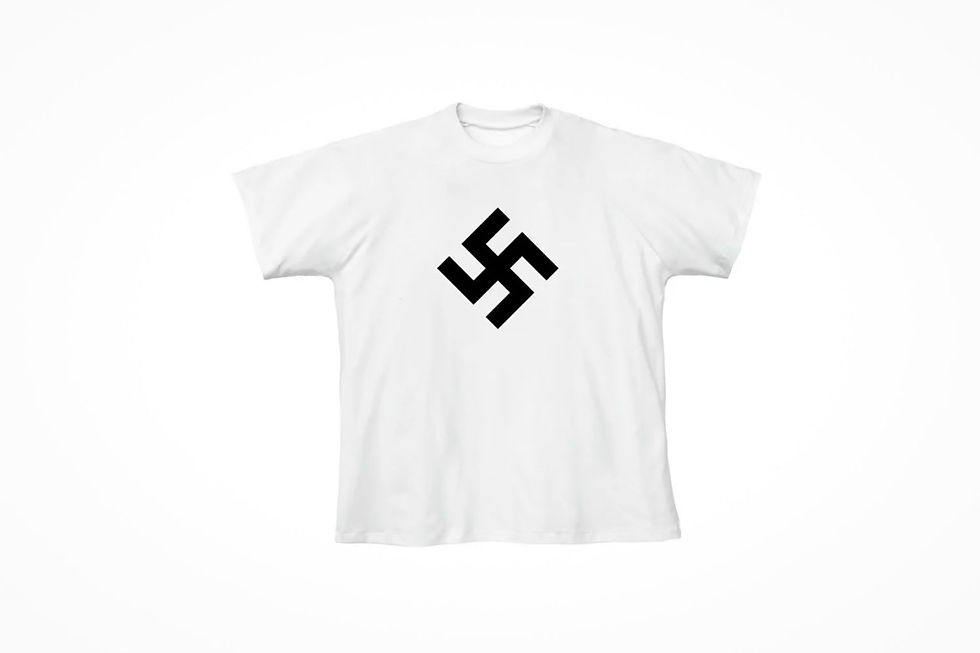
Symbols such as the Schwarze Sonne (Black Sun) or the Celtic Cross (also known as Odin’s Cross, Sun Cross or Wheel Cross) weren’t central to the Nazi Party but remain widely in use by Neo-Nazis due to its low recognizability. In the United States, the eagle, a symbol long associated with power and patriotism, was easily reappropriated into the Neo-Nazi lexicon. Adapted from the Nazi Reichsadler and fused with American nationalist imagery, it allowed the movement to merge fascism with patriotism, rebranding old hate under familiar colors.
We can see that there are two main categories under which the origins of Neo-Nazi imagery fall under: symbols directly inherited from the original Nazi Party, often rebranded or disguised to avoid recognition, and visual elements borrowed from other subcultures or national narratives that align with extremist ideologies. This means that the visual culture of Neo-Nazis is indeed as their name suggests a blend of the old and new, but it is important to note that it reflects appropriation rather than innovation. The result is that any existing subculture that exists wihtin the same scope as an extremist movement is susceptible to be abused and reframed by them. This became evident in the 1980s and 1990s, when Neo-Nazi culture merged with skin-head and heavy metal scenes. Tattoos and band logos replaced uniforms, transforming the human body into a political surface. Ironically, this celebration of individual self-expression stands in stark contrast to the Nazi regime’s original obsession with bodily purity and uniformity.

The Digital Evolution: Origins of Nazi Visual Culture in Online Platforms
Violent extremism has surged in recent years, claiming the lives of countless innocent people. Today, more than ever, it is crucial to be aware of the dangers of extremist rhetoric, particularly in how hateful agendas are spread through new media environments. Although legal frameworks to curb incitement and terrorism have expanded, the digital age has simultaneously provided extremists with unprecedented platforms for the dissemination of racist ideologies and the recruitment of followers. Digitization has reshaped the visual culture of extremism, fostering not only a distinct, online aesthetic but also multiplying the platforms through which extremists attract and engage new audiences.
The visual aesthetics of online extremism draw heavily from Neo-Nazi ideology and its predecessors, combining nationalist motifs with symbols from the Third Reich and the KKK. Flat, high-contrast colors, often black, white, and red adapted for digital screens, form a new visual subculture, while Americanized Fraktur fonts echo Nazi typographic traditions. Unlike the centralized design of Nazi propaganda, digital Neo-Nazi imagery has fragmented into countless adaptations to remain relevant and evade censorship, creating a niche aesthetic where digitization meets extremism. An example of such an element is a phenomenon known as “copypastas”: chains of text copied and pasted at specific places to shape swastikas. The ADL estimated that there are 1.83 million unique copypastas displaying antisemitic symbols such as the “happy merchant”, Totenkopf, and sonnenrod, with about 50% being a swastika. Even simply the use of specific numbers such as 14 and 88 are used as coded language between users: “14” referencing the white supremacist slogan known as the “Fourteen Words,” and “88,” derived from the eighth letter of the alphabet, standing for “Heil Hitler.” These symbols allowed adherents to signal allegiance in plain sight while maintaining plausible deniability.

Internet culture doesn’t just provide with platforms in which hate speech is repackaged and contextualized, it has also transformed its form. As a means to target younger audiences in particular we can see that humor and irony have become strategic tools of indoctrination which make extremism appealing and even trendy. This can be seen in the rising issue of the weaponization of internet memes for example, with a prominent case being the addition of the Pepe the Frog meme to the ADL (Anti-Defamation League) hate symbol database.

This pattern of using technology, internet culture and online spaces as tools for indoctrination shows us that the digital sphere has become a tool for disseminating extremist ideology: making it faster, more subtle and deeper embedded into our everyday culture. The survival of Neo-Nazi ideology in online spaces shows us that while ideology endures through whatever vacuum it can exist in, it is visual culture that allows it to spread and function. As we move further into a world shaped by AI, algorithms, anonymity, and visual overload, our duty of recognizing and resisting these messages becomes more complex and urgent with time.
Conclusion: The Relationship Between Design, Ideology and Power
The origins of visual culture reveal the ideologies they serve. The design system of the Third Reich was inspired by strength, purity and imperial unity, transforming hatred into identity through aesthetics. American Neo-Nazism rebranded these same ideals within a nationalist framework, masking hate with patriotism. The digital age has expanded and fragmented this legacy, allowing radical ideology to adapt to technology, internet culture, and younger audiences. Censorship unfortunately only drives these adaptations to mutate and reinvent themselves, often in more subtle ways. Whether it’s the use of swastikas in video games, celebrities accused of Nazi salutes, or AI-generated propaganda, extremism feeds on visibility and reinterpretation.
Technology has now added an additional layer to this dynamic. The University of Zurich’s recent, controverial study on AI’s ability to change opinions illustrates how persuasion has entered a new era. Large language models (LLMs) and algorithmic systems can tailor messages to users’ identities, potentially amplifying extremist influence at an unprecedented scale. These developments highlight the ethical responsibilities of both technology companies and the public to recognize that digital tools of communication can easily become tools of manipulation.
Disguising extremism as an identity is what has allowed radical ideology to persist within Western, democratic societies. This is done through unified and collective visual identity that is repurposed and rebranded to fit modern narratives and remain relevant. With the recent rise in violent extremism, white supremacy and global antisemitism, their visual culture remains a vital intrument of recutiment and power. Understanding its evolution, therefore, is not just an academic pursuit but a moral one. As long as hatred continues to rebrand itself, the ability to recognize it no matter the form it takes, remains our only hope of staying one step ahead.
Bibliography
Adolf Hitler. Mein Kampf. Translated by Ralph Manheim. Boston: Houghton Mifflin, 1971.
Alastair Reed and Jennifer Dowling. “The Role of Historical Narratives in Extremist Propaganda.” Defence Strategic Communications 4 (Spring 2018): 91. https://stratcomcoe.org/cuploads/pfiles/3-reed_.pdf.
Anti-Defamation League. Steam-Powered Hate: Top Gaming Site Rife with Extremism and Antisemitism. New York: Anti-Defamation League, 2023. https://www.adl.org/resources/report/steam-powered-hate-top-gaming-site-rife-extremism-antisemitism.
Brandenburgische Landeszentrale für politische Bildung. “Führerprinzip.” Last modified July 2025. Accessed October 3, 2025. https://www.politische-bildung-brandenburg.de/lexikon/fuehrerprinzip.
Epstein, Evan. “How LBJ’s Daisy Ad Transformed American Politics.” Gilder Lehrman Institute of American History,September 2023. Accessed August 30, 2025. https://www.gilderlehrman.org/sites/default/files/2023-09/Epstein_0.pdf.
Hao, Karen. “Unethical AI Research on Reddit under Fire.” Science, August 14, 2023. https://www.science.org/content/article/unethical-ai-research-reddit-under-fire.
Hilton Kramer. “At the Bauhaus: The Fate of Art in ‘The Cathedral of Socialism.’” The New Criterion 12, no. 7 (March 1994): 4.
Hoffmann, D. L., A. W. Pike, M. García-Diez, P. B. Pettitt, and J. Zilhão. “Methods for U-Series Dating of CaCO₃ Crusts Associated with Palaeolithic Cave Art and Application to Iberian Sites.” Quaternary Geochronology 36 (2016): 104–19. https://doi.org/10.1016/j.quageo.2016.07.004.
History.com Editors. “‘The Birth of a Nation.’” History.com. Last modified August 21, 2018. https://www.history.com/articles/kkk-birth-of-a-nation-film.
James Q. Whitman. Hitler’s American Model: The United States and the Making of Nazi Race Law. Princeton and Oxford: Princeton University Press, 2017.
Melvyn Stokes. D. W. Griffith’s The Birth of a Nation: A History of “The Most Controversial Motion Picture of All Time.” New York: Oxford University Press, 2007.
New York Times. “Eagle Was Used as Symbol of Ancient Etruscan Race.” New York Times, September 9, 1928. https://www.nytimes.com/1928/09/09/archives/eagle-was-used-as-symbol-of-ancient-etruscan-race.html.
United States Holocaust Memorial Museum. “Why We Need to Study Nazi Propaganda.” Memory & Action (Medium), December 10, 2021. https://medium.com/memory-action/why-we-need-to-study-nazi-propaganda-69c7419b5a54.
United States Holocaust Memorial Museum. Law, Justice, and the Holocaust. Washington, DC: United States Holocaust Memorial Museum, 2009. https://www.ushmm.org/m/pdfs/20091123-ljh-antisemitic-law.pdf.
Verfassungen der Welt. “Erlaß über die Errichtung des Reichsministeriums für Volksaufklärung und Propaganda vom 13. März 1933” [Decree on the Establishment of the Reich Ministry for Public Enlightenment and Propaganda of 13 March 1933]. Accessed November 21, 2022. https://www.verfassungen.de/de33-45/propaganda33-2.htm.
Victoria and Albert Museum. “Entartete Kunst: The Nazis' Inventory of ‘Degenerate Art.’” Accessed August 31, 2025. https://www.vam.ac.uk/articles/entartete-kunst-the-nazis-inventory-of-degenerate-art

Very well written