
Conflict By Design: On Iran, AI and The Visual Economy

Designing Conflict: From Cold War Biopolitics to the Digital Panopticon of the Middle East
By Anya Rubstein
Supervised by Dr. Ofri Cnaani
Submitted to the Bezalel Academy of Arts and Design
April 2026
Abstract
This paper examines the evolution of the "design of conflict" from the biopolitical mass propaganda of the Cold War to the panoptic, algorithmic warfare of the Middle East. Through a visual analysis of historical political campaigns, proxy-war material culture, contemporary drone interfaces, and interactive data mapping, the research investigates how visual communications operate as tools of warfare. Ultimately, it seeks to understand how the shift from public, printed propaganda to the operational images on our smartphones alters our comprehension of violence. It concludes that contemporary visual communications are increasingly weaponized by power structures as a method of polarization, sustaining perpetual conflict.
Introduction
War is not merely fought on physical battlefields; it is designed, coded, and distributed through visual culture and interfaces. Historically, global catastrophes and ideological conflicts were mediated to the public through meticulously engineered printed propaganda or televised broadcasts aimed at biopolitical population control. Today, as Dr. Ofri Cnaani notes, the crisis rests "in the palm of our hands." A casual scroll on a smartphone exposes us to cruel images on a daily basis, making us exist in a perpetual state of emergency.
The rise of AI and deepfakes further enables this power over the general population. By engaging with concepts of the operational and cruel image, this paper invites the reader to explore the "design of conflict": tracing the aesthetic and technological lineage of how regimes visualize violence, and how we are conditioned to witness it. While visual communications possess the potential to build empathy and document truth, they are overwhelmingly weaponized by state apparatuses, NGOs, and algorithms alike to curate one-sided narratives. This deliberate design of polarization serves higher geopolitical interests, ensuring that populations remain divided and perpetually mobilized for conflict.
The Theoretical Space
To trace the evolution of conflict design, we must first establish the theoretical frameworks governing how power interacts with the visible world. Modern warfare demonstrates a shift from the management of life to the industrial administration of death, and finally, to the statistical abstraction of the target.
Biopolitics, State Racism, and the Holocaust
The concept of Biopolitics was developed by French philosopher Michel Foucault to explain a profound shift in modern state power. In the Middle Ages, sovereign power was defined by the right to "take life or let live"; power was demonstrated by public execution. With industrialization, however, the state needed a healthy workforce. Power shifted to the capacity to "make live and let die." Biopolitics emerged as the calculated management of populations through demographics, hygiene, and urban planning.
To justify war within a system focused on protecting life, Foucault argued the state introduces state racism. The biopolitical state visually and conceptually divides the population into biological categories: those who must live and those deemed a biological threat. This framework reached its catastrophic climax during the Holocaust. The Nazi regime utilized pseudo-scientific biology and massive bureaucratic apparatuses to engineer the elimination of minorities as a massive public health initiative.
Building upon Foucault, Giorgio Agamben introduced the concept of Bare Life. Agamben argued that the concentration camp is the true political paradigm of modernity. Within the camp, the state creates a "state of exception" where populations are stripped of their legal identities and reduced entirely to sheer biological existence. They can be killed without it being considered a crime.
From Biopolitics to Necropolitics
Postcolonial theorist Achille Mbembe expanded this discourse with his essay Necropolitics, arguing that Foucault’s biopolitics was insufficient to describe contemporary asymmetrical warfare, particularly in the Middle East. Mbembe describes "death-worlds," unique forms of social existence where vast populations are subjected to conditions that confer upon them the status of the living dead. Entire territories are spatially fragmented and subjected to overwhelming military technology, keeping the population in a permanent state of subjugation.
As the nature of power shifts from biopolitics to necropolitics, the visual interfaces of war adapt:
The Cruel Image: Oraib Toukan defines this as vernacular, graphic documentation of ruined bodies. By circulating raw trauma through digital networks, the cruel image bypasses rational discourse to directly assault the nervous system, turning the passive consumer into an immediate witness.
The Operational Image: Harun Farocki and Trevor Paglen define these as visual data made by machines, for machines. Drone navigation feeds and targeting crosshairs do not represent reality for a human viewer; they trigger automated processes, removing human empathy from the visual equation of war.
The Mean Image: Hito Steyerl identifies this as an algorithmic rendering based on statistical averages and massive data dragnets. It replaces indexical photographic truth with calculated probability, reducing the complexity of human existence into a flattened, statistical UI element where an algorithm dictates who is a target.
This algorithmic panopticon begins long before a drone takes flight. Datasets like Microsoft’s MS-Celeb-1M scraped ten million images of individuals from the internet without consent to train machine learning models. When the human face is reduced to harvestable data points, the ethical boundaries of conflict are compromised at the level of the archive. The algorithmic confidence score that eventually flashes on a military UI is a direct descendant of this non-consensual scraping, proving that modern warfare is built upon the weaponization of our digital reflections.
The Methodological Space

The visualization of conflict is not a modern invention. In the Roman Empire, the circulation of Judaea Capta coins functioned as early interfaces of biopower, visually instructing citizens on the fate of their enemies. However, following the Second World War, the mechanisms of visual control shifted into the domestic sphere. By analyzing historical case studies, we can trace a clear trajectory of the visual interface of war: from top-down state persuasion, to bottom-up material documentation, and finally to the automated calculation of the algorithmic screen.
Biopower through American Advertising
The Daisy Ad is one of the earliest examples of media used to instill fear at a time of war. Created by the Doyle Dane Bernbach Agency for Lyndon B. Johnson’s 1964 presidential campaign, the ad weaponized visual media to provoke an immediate somatic response.
The ad begins with a wide shot of a three-year-old girl plucking petals off a flower, counting incorrectly. As she reaches nine, a voice from a loudspeaker begins counting down from ten to zero like a missile launch. The camera zooms in on her eye until the screen is entirely black, and on "zero," a nuclear explosion is shown in a series of devastating shots. By concluding with the absolute devastation of a nuclear blast, the ad demonstrated that the screen could be used to directly assault the nervous system of the public, collapsing the distance between domestic safety and total annihilation.
Soviet Propaganda as a Tool for Biopolitics
While the Daisy Ad weaponized anticipatory terror, the visual design of conflict across the Iron Curtain operated on an instructional frequency. To understand this, we can look at the photomontages of Nikolai Dolgorukov. In his anti-imperialist campaigns, the composition is strictly hierarchical. The Soviet worker is rendered in monumental scale, bathed in the ideological red of the state. In stark contrast, the Western capitalist threat is physically diminished, caricatured in chaotic black-and-white, and visually crushed beneath the weight of Soviet industry.
The typography does not ask a question; it issues a command in bold, constructivist lettering. The poster acted as a daily, public interface that trained the nervous system of the Soviet citizen to equate physical labor with survival. The visual economy of the poster normalized a state of constant, heroic struggle.
Cruel Images and Vernacular Craft
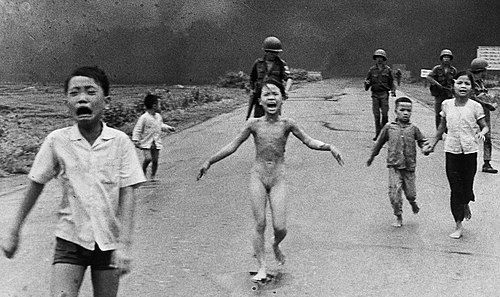
This state monopoly on visual narratives was shattered during the proxy wars. Nick Ut’s Pulitzer Prize-winning 1972 photograph from Vietnam, "The Terror of War," serves as the ultimate rupture. Shot in stark black and white, the composition centers on nine-year-old Phan Thi Kim Phúc fleeing naked and severely burned following a napalm strike. The raw, kinetic horror of the children is juxtaposed against the casual posture of the soldiers walking behind them. This photograph strips away engineered fear and replaces it with indexical trauma, functioning as a prime iteration of Toukan’s "cruel image."

If the Cold War was designed from the top down, the visual economy of the proxy wars also emerged from the bottom up. As violence spilled into Afghanistan, the "design of conflict" shifted into the domestic interior through Afghan war rugs. In a traditional Afghan rug, symmetrical grids and floral medallions create a harmonious space. In the war rugs, this foundational grid is hijacked by mechanized violence. The pixel-like structure of the hand-tied knots is used to meticulously render Soviet helicopters and Kalashnikov rifles.
The weavers, many of whom were displaced refugees, were active agents of visual culture. By knotting the tools of their destruction into an object of domesticity, the rug became a decentralized medium of journalism. The weaver emerges as a crucial visual communicator, translating the reality of violence into a permanent material record.
The Ethics of Interface: Designing the Operational Image
As the theater of war entered the twenty-first century, the visual economy severed from physical material. The camera shifted into the nose of the unmanned aerial vehicle, and visual communications were engineered as operational data.
The translation of Steyerl’s "Mean Image" into a military dashboard presents a concrete design challenge. During my military service in the IDF, I worked on the development of AI-integrated drones in collaboration with Elbit Systems. These systems were designed for precise, targeted defense to identify and strike the launch sources of incoming missiles. In this context, the military screen functions as a dashboard of probabilities. When a projectile is fired, the AI processes spatial data and trajectory physics. The UI designer’s task is to translate this invisible data into legible visual cues, such as augmented reality bounding boxes and confidence scores.
Crucially, military strikes require a strict chain of command and multi-layered verification. The ethical burden of UI design lies in providing accurate situational awareness without inducing automation bias. If the interface is too cluttered, it causes information overload. If it oversimplifies the algorithm's margin of error with highly authoritative graphics, it risks creating an undue reliance on the machine's statistical assumptions. The developer is tasked with an incredibly fraught design problem: creating an interface legible enough to prevent the loss of civilian life, yet nuanced enough to keep the human in the loop.
The Post-Screen Interface: Hybrid Intelligence
The future of this architecture seeks to bypass the screen entirely. In early 2026, Dr. Alona Barnea, Director of the Neurotechnology Division at Israel’s Directorate of Defense Research & Development, outlined the military's pursuit of "hybrid intelligence." This focuses on brain-machine interfaces, allowing operators to communicate with swarms of drones through neural signals rather than graphic displays.
This represents the ultimate synthesis of Foucault’s biopolitics and Steyerl’s machine gaze. The "design" of conflict is no longer about adjusting the color-coding of a bounding box; it is about tethering the human nervous system directly to the kill chain. The human mind itself is engineered to become the final architecture of the algorithmic panopticon.
Mapping Trauma, Terror, and the State
As the state’s gaze becomes automated, the same technological infrastructure opens a new frontier for cartographic warfare. The interactive map is a highly engineered interface of power and polarization.
Projects by agencies like Forensic Architecture utilize the sterile aesthetic of data visualization to map structural damage in Gaza. Yet, by mapping damage while frequently stripping away the context of the deeply embedded, subterranean terror infrastructure, these maps function as highly funded, one-sided visual economies. They actively design a narrative. Conversely, Israeli maps produced by the INSS aim to visualize the unseen, mapping labyrinthine tunnel networks beneath civilian infrastructure to legitimize defensive military actions.
Furthermore, to understand the visual communications of this region, one must examine how design documents trauma. A profound example is oct7map.com, a geo-visualization project created after the October 7 massacres. The interactive map places red dots for every individual murdered and blue dots for every person kidnapped. Clicking a specific point reveals the victim's name and story. The abstraction of data is inverted; it painstakingly re-humanizes the victims of terror, functioning as a digital war rug.
When viewed together, a tragic paradox emerges. Rather than creating a unified truth, these beautifully designed data visualizations create impenetrable echo chambers of trauma. They are weaponized by political entities to justify ongoing violence. Because perpetual conflict serves the geopolitical interests of these power structures, cartographic interfaces are deployed to ensure opposing populations never look at the same map.
A Warzone of Interfaces
Finally, the "map" expands beyond physical geography into cognitive warfare. We are currently witnessing the "first true AI war" (Shahaf 2026). This frictionless automation is actively weaponized against the cognitive map of the public.
The ISNAD campaign, a coordinated influence operation affiliated with the Muslim Brotherhood, utilizes generative AI to deploy thousands of fake Hebrew-language profiles. INSS researcher Reut David identifies this strategy as "sociological warfare." These algorithms target psychological vulnerabilities, constructing narratives of despair to slowly erode the public's commitment to their national project (Siman-Tov and David 2026).
If the 1964 Daisy Ad weaponized anticipatory terror through a single broadcast, campaigns like ISNAD atomize this warfare. They deliver algorithmic terror directly to smartphones. The ultimate objective is not to capture physical territory, but to induce despair and eliminate the state from within. By dictating exactly how this conflict is consumed by the world, visual communication is no longer just a byproduct of war: it is the very engine that sustains it.
Reflection and Conclusion
The technological frameworks we engage with as designers, specifically machine learning architectures, spatial mapping software, and user interfaces, are fundamentally neutral. They are the exact same building blocks used by defense contractors to engineer the automated kill-chain, and by visual researchers to dismantle state narratives through counter-forensics.
Studying visual communications at Bezalel Academy of Art and Design in Jerusalem strips away the luxury of treating these tools as abstract theory. Here, the algorithmic panopticon is a tangible reality. This was acutely demonstrated during a course visit to the Jerusalem Municipality Security Room. Observing the vast network of cameras and screens utilized by the municipality materialized Foucault’s theories into a localized, operational interface. The design of information in this region is not a subject of mere critique; it literally dictates the threshold between life and death.
As I write this conclusion between sprints to the local bomb shelter, navigating the reality of a second war with Iran during my degree, I cannot ignore the absurdity of discussing the power of images during times of actual, physical war. Born in New York City just months before the September 11 attacks and having immigrated to Israel at the height of the Second Intifada, my life feels like a series of events dictated by the visual economy of terror. The truth of the matter is that with the rise of AI, the era of objective truth may soon be over. It is more crucial than ever to study real images, not just cruel ones, and to be able to distinguish between the narratives that control us and the narratives that empower us.
As a designer, I choose to believe that if the interface of war is meticulously designed, it can also be reverse-engineered. The ongoing war with Iran, much like the devastation witnessed in Gaza over the last few years, proves that the weaponization of the visual narrative is not a temporary anomaly. Driven by generative AI and state-sponsored algorithms, this deliberate control over what populations see, and consequently how they are mobilized to fight, is a permanent fixture of modern warfare. The future of our discipline must leverage technology not for biopolitical control, but for human rights defense and the dismantling of these echo chambers. By adopting the methodologies of visual resistance, designers can ensure that these tools act as mechanisms for objective truth rather than state propaganda.
Bibliography
Agamben, Giorgio. 1998. Homo Sacer: Sovereign Power and Bare Life. Translated by Daniel Heller-Roazen. Stanford: Stanford University Press. Baylor University. 2022. "Propaganda in Color: Examining Soviet-Era Posters with HIST 4379." Keston Center for Religion, Politics, and Society. Browning, James. 2024. "Newly Digitized Posters Trace 70 Years of Soviet Propaganda." Davis Center for Russian and Eurasian Studies. CQ Press. 2009. Guide to U.S. Elections. 6th ed. Washington, D.C.: CQ Press/Sage. Crawford, Kate, and Vladan Joler. 2018. "Anatomy of an AI System." AI Now Institute and Share Lab. Farocki, Harun. 2004. "Phantom Images." Public 29: 12-22. Forensic Architecture. n.d. "About Agency." Accessed February 2026. Foucault, Michel. 1995. Discipline and Punish: The Birth of the Prison. Translated by Alan Sheridan. New York: Vintage Books. Foucault, Michel. 2003. "Society Must Be Defended": Lectures at the Collège de France, 1975-1976. Translated by David Macey. New York: Picador. Fuller, Matthew, and Eyal Weizman. 2021. Investigative Aesthetics. London: Verso. Guo, Yandong, et al. 2016. "MS-Celeb-1M: A Dataset and Benchmark for Large-Scale Face Recognition." Microsoft Research. Mbembe, Achille. 2003. "Necropolitics." Translated by Libby Meintjes. Public Culture 15 (1): 11-40. Paglen, Trevor. 2014. "Operational Images." e-flux Journal 59 (November). Shahaf, Tal. 2026. "The bots struck at dawn: inside the AI systems, drones and algorithms reshaping Israel’s war." Ynetnews, March 8. Siman-Tov, David, and Reut David. 2026. "The ISNAD Campaign Against Israel: Toward a New Strategy?" INSS Insight No. 2102 (February 23). Sontag, Susan. 2003. Regarding the Pain of Others. New York: Farrar, Straus and Giroux. Steyerl, Hito. 2023. "Mean Images." New Left Review 140/141 (March to June). Toukan, Oraib. 2019. "Cruel Images." e-flux Journal 96 (January).


Fascinating!