
The Philosophy of Art and Design

Updated: Apr 11
The Israel Arts and Science Academy | Jerusalem
Final Thesis in Art
Advisor | Dr. Tal Schottenstein
Dec 2018
Introduction
Art has always been a huge and inseparable part of my life, primarily due to the fact that my father was an artist. For me, art has always been a means of finding understanding in the world around me. Therefore, when a friend asked me why a logo isn't considered art but Andy Warhol's Brillo Boxes are, I was stumped. So I did what any normal person would do and dedicated my 50 page senior thesis to answering this problem. Thanks to Gemini, you can read a shortened version in just a few minutes to kill some time and hopefully learn some things about the philosophy of art and advertising.
A Philosophical Discussion on the Use of Commercial Trademarks in Art
Plato defined art as an imitation of reality back in his time. He thought imitating nature was just an existing trait in human behavior. Today our reality includes a much more diverse environment thanks to human development, making it easier to see the significant role of commerce and commercial design in our lives. Even though commercial trademarks had no place in artistic theory back then, Plato already answered the basic question of why commercial trademarks appear in art. Using everyday objects in art became widespread and recognized as its own genre when the Dadaist movement broke through in the early 20th century.
The theme of borrowing from reality is really obvious in Andy Warhol's Brillo Boxes, and people have very different opinions on whether the work can truly be considered art. In his 1964 essay "The Artworld," the philosopher Arthur Danto attempts to prove why the Brillo Boxes are considered a work of art. He opens the essay by arguing against Plato's imitation theory. Danto says that because artists used to be so focused on imitating reality, the flaws in Plato's theory went unnoticed until the invention of the camera. Once cameras existed, art challenged the old theory because its goal was no longer just to imitate what we see. Danto created a new concept called the "Reality Theory" to show that modern art was not trying to look realistic at all. This is where Dada and Pop artworks come into play, such as Robert Rauschenberg's Bed. This work is quite literally a real bed hung on a wall that Rauschenberg drew on with pencil and oil paint.
To explain this, Danto introduces a hypothetical character named Testadura. Testadura approaches this artwork as a regular bed and thinks the paint stains just represent the clumsiness of whoever slept there. Danto explains that people like Testadura lack an understanding of the artistic atmosphere and the knowledge of art history. Danto calls this background knowledge the Artworld. Ultimately, what changes Testadura's mind is a new artistic theory that prevents an artwork from being seen as just a regular object. Danto demonstrates this by looking at Warhol's Brillo Boxes. Warhol's work has no real material value because the cardboard and paint are not what make it an artwork. Works similar to his are actually developing the theory of the Artworld itself.
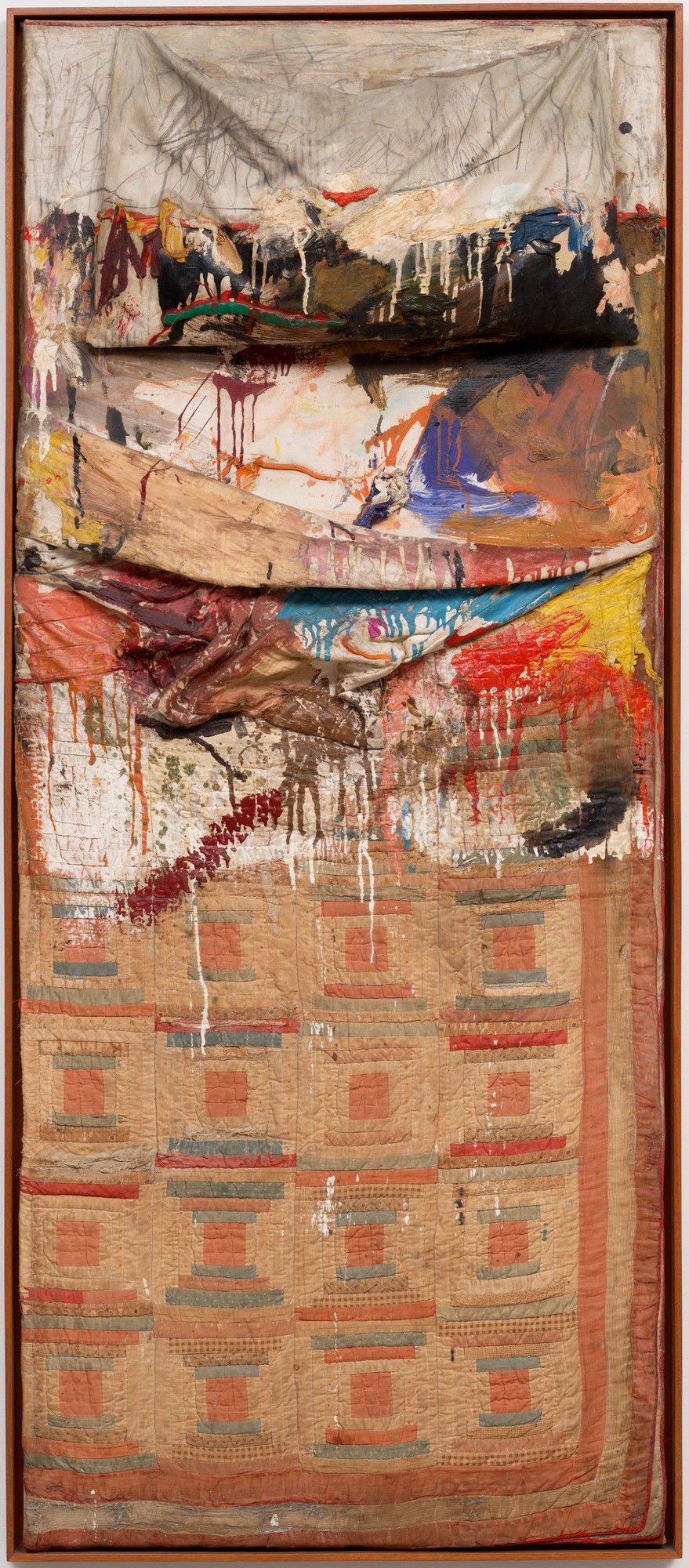
Robert Rauschenberg, "Bed", MOMA, 1955
Logos in Art
The use of logos and graphic commerce within an artwork became a massive hallmark for the Pop artists of the 60s, who put the commercial world on an artistic pedestal. Many of the artists from this period already had a background in commercial design. Very quickly, as a result of the expanding middle class and the boom of consumerism, logos became a major part of the everyday environment.
Because of this, it is not surprising that Pop artists brought commercial design into their art. While other artists painted logos in the background of their pictures, Warhol turned the logo into the main artwork itself. Warhol was very careful to make his boxes look exactly like the original Brillo boxes in every possible way. Representing the boxes exactly as they look in reality reminds people of the Dada movement, but Warhol's work is different from Dada because he actually built and painted these boxes himself. According to writers Mark Tribe and Reena Jana, Dadaist collages and the Brillo Boxes reflect how mass production changed the status of artistic creativity. The development of mechanical reproduction allowed artists to easily use found images and sounds in their works, showing how consumerism offered an alternative way to be creative.
A Historical Overview
Thanks to advancements in science and technology, we live in a globalized era that makes marketing and advertising incredibly important. But the phenomenon of logos actually comes from a massive expansion of commerce thousands of years ago that led to a need to distinguish between different suppliers.
When humans started living together in villages, it led to property ownership and specialized trades. These two things made visual identifiers completely necessary. In order to distinguish between products, people used seals. Let us take for example the Tyszkiewicz cylinder discovered in the Near East Anatolian Hittite region, which was likely created between 1650 and 1200 BCE. It is made using a specific printing technique where a stamp is pressed into a surface to create an image. On this cylinder, mythological scenes and gods are depicted between a pattern of spirals. This cylinder is an example of one of the first brands in history. These cylinders were mass produced, marking the first time in the history of graphic design that people would indicate who an image belonged to.

The Tyszkiewicz cylinder, 1650 - 1200 BCE
The clear connection between a visual image and its meaning forms the basis of the contemporary logo, and it existed back then in Egyptian hieroglyphics and Chinese calligraphy too. In Egypt, everyone had a personal seal, mostly in the shape of a scarab beetle, such as the famous seal featuring the name of Akhenaten together with the name of Nefertiti.
Commercial competitiveness reached a new peak in the Middle Ages across Europe due to the extreme popularity of beer. In 1389 CE, King Richard II passed a law requiring beer suppliers to hang a sign outside their brewery that included an appropriate symbol. Because a huge part of the population could not read, symbols representing beer suppliers had to focus on a simple image and use bright stylistic features in order to appeal to the whole public.

Another logo from that time period was the family crest used by noble families. The accepted theory is that these symbols served as a means of identifying warriors on the battlefield, though experts like Arthur Charles Fox Davies argue they were also just a means of decoration. Every single detail in a family crest created a visual and personal image completely unique to its owner.
Later on during the Industrial Revolution, changes in the printing press allowed for the mass production of printed materials in full color. This broadened the possibilities for logo designers because they were no longer dependent on simple pictures and could finally use words, enabling the invention of the slogan. Because of higher general education, a massive leap occurred in typeface design and typography. The combination of typography together with images developed a new style and led to the invention of the poster. Pierre Bonnard won an advertising competition with his poster work France Champagne.

Pierre Bonnard, France-Champagne, 1889
This Art Nouveau style greatly influenced overall graphic design, and there is a shared use of stylistic features between these posters and corporate logos. The Coca Cola logo, designed in 1886, is an excellent example. With the help of redesigns that adapted to their specific era, the Coca Cola logo managed to survive for over a century without extreme changes and retain its iconic status. Its use of special typography and contour lines directly reflects the art of that time period.

The Coca Cola Logo on a Bottle, 1885
The Use of Commercial Trademarks in the Works of Andy Warhol
Pop Art and Biographical Background Artists like Roy Lichtenstein, Claes Oldenburg, and Andy Warhol heavily used iconic images from TV ads and billboards. The world of commerce became a central theme in their works, and its representation demanded a redefinition of art. Warhol's success in the commercial design market was made possible by the support of his parents, who immigrated to the United States. Warhol grew up in Pittsburgh and later moved to New York.
His career blossomed with his first solo exhibition in 1962, displaying "Campbell's Soup Cans." Even though Warhol was not yet producing his works en masse, the presentation represented the mass configuration of products. The question of how his works could be defined as artworks arose with his second exhibition at the Stable Gallery in 1964, where he presented the Brillo Boxes.
The Brillo Boxes
The design of Warhol's boxes is identical to that of the Brillo boxes. The combination of red, white, and blue creates a balanced combination that is important to US residents because it comprises the national flag. The choice of colors indicates a patriotic branding tactic used to encourage customers to show love for their country. The composition emphasizes the company name and the product.

Brillo Boxes © 2026 Andy Warhol Foundation for the Visual Arts/Artists Rights Society (ARS), New York
The resemblance between Warhol's boxes and those of the Brillo company is also evident in the way they are displayed. The messy and scattered arrangement recalls the natural state of the boxes at home, evoking a feeling of recognition. What interested Warhol in these images was their iconicity, the extent to which anyone can recognize them. Thus, he turned the product into a representation of equality. In 1985, Warhol released a series of paintings of famous logos like Apple, using a colorful and spontaneous style while maintaining the square shape of graphic design canvases.
Reactions Warhol's works received diverse reactions. Marcel Duchamp reacted to the Campbell's Soup Cans by arguing that Warhol was interested in the concept that makes an artist want to copy the image, rather than the visual image itself. Arthur Danto felt the need to address the question raised by the Brillo Boxes, leading to his famous lecture "The Artworld." He argued that art and the everyday are indistinguishable because Warhol's art contained signs that are strong and close to the life of the individual in society.
Commercial Design and Art in Contemporary Culture
The invention of the computer completely changed graphic design. The ability to draw on a computer materialized in the 60s and opened many doors. The computer allowed for absolute control over shapes and text, facilitating the process of graphic design. This technological advancement initiated new techniques and artistic movements, such as digital art and computer art.
Computer art utilizes the basic operations a computer offers, using codes as tools to build artworks. Warhol's first introduction to a computer occurred in 1984 when Steve Jobs showed him how to use a Macintosh. Warhol later created a digital version of the soup cans. However, computer art received negative criticism. Brian Reffin Smith argued that computer art is graphic design that only demonstrates the capabilities of a computer, stating that producers of computer art are often too tied to commercialism.

Andy Warhol, Campbell’s, 1985, ©The Andy Warhol Foundation for the Visual Arts, Inc.
Logos Today
To understand the universal aspiration of logos today, we must look at the Apple logo, designed in 1976. The original logo depicted Isaac Newton sitting under a tree. It looked more like a work of art than a commercial symbol. Steve Jobs asked for a redesign a year later, resulting in the iconic shape of the apple with a bite in six colors. The logo was later replaced by a black apple in 1998, keeping the iconic shape but taking on a simpler appearance. Based on the redesign of the logo, one can see that the goal of its design is almost always simplicity and clarity, the characteristics of flat design.

Evolution of the Apple Logo
Discussion and Conclusions
The subject of logos in relation to art challenges the definition of art. Even though contemporary art seems to have no boundaries, social conventions can immediately separate a familiar logo from a work of art. Warhol's extreme move in the art world contradicted expectations. Warhol and Marcel Duchamp are considered the greatest influences on the question of what art is. While Duchamp erased the requirement for aesthetics, Warhol pushed the boundaries further.
Warhol's Brillo Boxes are not authentic Brillo boxes. In a symbolic sense, Warhol captures the image of the boxes and freezes it into an eternal artwork as a statement on the power of a brand. This brings up the definition of meaning or spirit by philosopher Georg Wilhelm Friedrich Hegel. Hegel argues everything has an objective spirit and an absolute spirit. The original Brillo boxes belong to the objective spirit of the United States. Warhol's boxes are part of that same objective spirit, but because they speak about it, they belong to the absolute spirit. Warhol's innovation was that one does not need to express the absolute spirit visually.
A definition for art still exists. Absolute spirit is the criterion that explains why art can be made from anything. The title of "art" creates a connection to the absolute spirit in our heads. The meaning a logo conveys can border on the meaning conveyed by an artwork, but their purposes are completely different. Today, the art world and the commercial design world are no longer separated by a box. While art has expanded its horizons, commercial design is dependent on public desires and technological needs. This is the real difference: technology rules commercial design while art utilizes technology for creating innovative images.

Comments